


Ganesh Dhole
1.
𝐌𝐞𝐥𝐨𝐝𝐲 𝐌𝐨𝐦𝐞𝐧𝐭
Eloni, Meloni—
green on dead bone;
you’re no Sonia,
nor Rajiv my own.
Chocolate handshakes,
desire in glove—
we spend, we pretend,
the media call it love.
Euros and rupees—
a nation pays;
you there in Italy,
I here—at ease.
We never ask
whose hunger feeds
this careful theatre—
we never ask.
2.
𝐖𝐡𝐞𝐧 𝐖𝐨𝐫𝐝𝐬 𝐂𝐡𝐚𝐧𝐠𝐞 𝐂𝐥𝐨𝐭𝐡𝐞𝐬
Meanings don’t die.
They just change clothes—
and begin to behave differently.
You say, “Jai Shri Ram.”
I say, “Joy Bangla.”
You lift “Hindi–Hindu–Hindustan”
like a flag.
I hold on to “Mother–Soil–People”
like memory.
It looks like a conversation.
It sounds like a dialogue.
But listen carefully—
it is neither.
It is a contest of echoes,
a rivalry of associations.
Tell me honestly—
when “Jai Shri Ram” reaches you,
does a gentle Ram arrive—
soft, restrained, dusk-coloured,
walking barefoot through your mind?
Or does he come escorted—
by loud voices, tightened jaws,
and slogans thrown like stones?
And when you hear “Joy Bangla,”
does something within you quietly begin to sing—
“Amar Sonar Bangla, ami tomay bhalobasi”—
like a field remembering the wind,
like a people remembering their first breath of freedom?
Do you see 1971—
a nation rising through fire and faith,
a voice becoming a country?
Or does something heavier sit beside it—
power, fatigue,
and the familiar smell of corruption—
a tyrant lady and her nephew?
Strange times.
Once, words carried meaning.
Now, they carry luggage.
There is, I am told,
a tidy phrase for this—
brand synonymity.
When a word forgets its own reflection
and borrows a louder face.
This is not about sides.
Sides are cheap.
They are available everywhere.
This is about something quieter—
how language,
that obedient, invisible worker,
has been recruited
into parades it never signed up for.
In our lifetime,
phrases that once folded hands
have learned to raise fists.
The other day, in a college store,
a boy said,
“Let’s Google it.”
A girl, without looking up, said,
“First xerox your copies.”
I smiled—
the way one smiles
at a familiar mistake.
“Both of you,” I said,
“are victims of verbification
and brand synonymity.”
They did not smile back.
Perhaps the words had already changed clothes.
Without even turning around, the boy said,
“You talk like my dad.”
I tugged lightly at his ponytail
and said, “I am your dad.”
3.
𝐓𝐰𝐨 𝐑𝐨𝐚𝐝𝐬, 𝐓𝐰𝐨 𝐒𝐤𝐢𝐞𝐬
One of my erudite pilot friends,
much younger than I am, said,
“Car accidents happen
more often
than air crashes.
So, the probability
of an air crash
is less than that of a car accident.”
I told him gently—
like a small morning story:
Car walks the road
all day, all night,
amid horns,
dust,
restless crossings.
A million wheels turn,
a million choices made—
left, right, stop, rush.
And sometimes…
he slips.
Sometimes…
he crashes.
Air moves differently.
She rises quietly,
cuts through silence,
floats in wide, empty blue.
No crowd.
No chaos.
just distance… and discipline.
And rarely…
very rarely—
she falls.
People stand below
and count.
“Look,” they say,
“Car falls more.
Air is safer.”
An old voice whispers—
“Count not the falls…
count the journeys.”
Car travels
a million paths a day.
Air travels
only a few.
So the truth sits gently,
like dust in sunlight—
Not all that happens more
is more likely.
Sometimes
it only happens more
because
it is given
more chances
to happen.
And between
two roads
and two skies—
probability
finds its quiet meaning.
4.
𝐀 𝐅𝐨𝐫𝐛𝐢𝐝𝐝𝐞𝐧 𝐁𝐨𝐨𝐤
Slowly, the distance
grew between us.
Words became fewer,
conversations faded,
and somewhere—
we lost the thread
of connection.
No more those long talks
over little things.
All the rights
I once claimed over you
now feel… meaningless.
You have become a book—
forbidden, distant, closed.
I stand outside your cover,
not allowed to look,
not allowed to read.
Once,
I knew every page of you—
touched your words,
breathed your silence,
read you slowly,
like something sacred.
Now,
even your title
feels out of reach—
like a name
I am forgetting
too slowly.
5.
𝐋𝐮𝐧𝐚𝐭𝐢𝐜 𝐒𝐮𝐫𝐚𝐭
Surat — a small world, a shop of dyes,
its colours flare, then quickly fade;
It laughs too loud at silent skies,
like secrets badly played.
Beneath a cracked and restless moon
I try to speak your name aloud;
The night begins to hum a tune —
half whisper, half unholy crowd.
In narrow lanes the arguments spin,
like kites that tangle, snap, and fall;
No one knows where games begin —
or who has lost it all.
And in this bright, unsteady art,
where painted smiles depart —
Lunatic Surat keeps my heart,
and will not let it part.
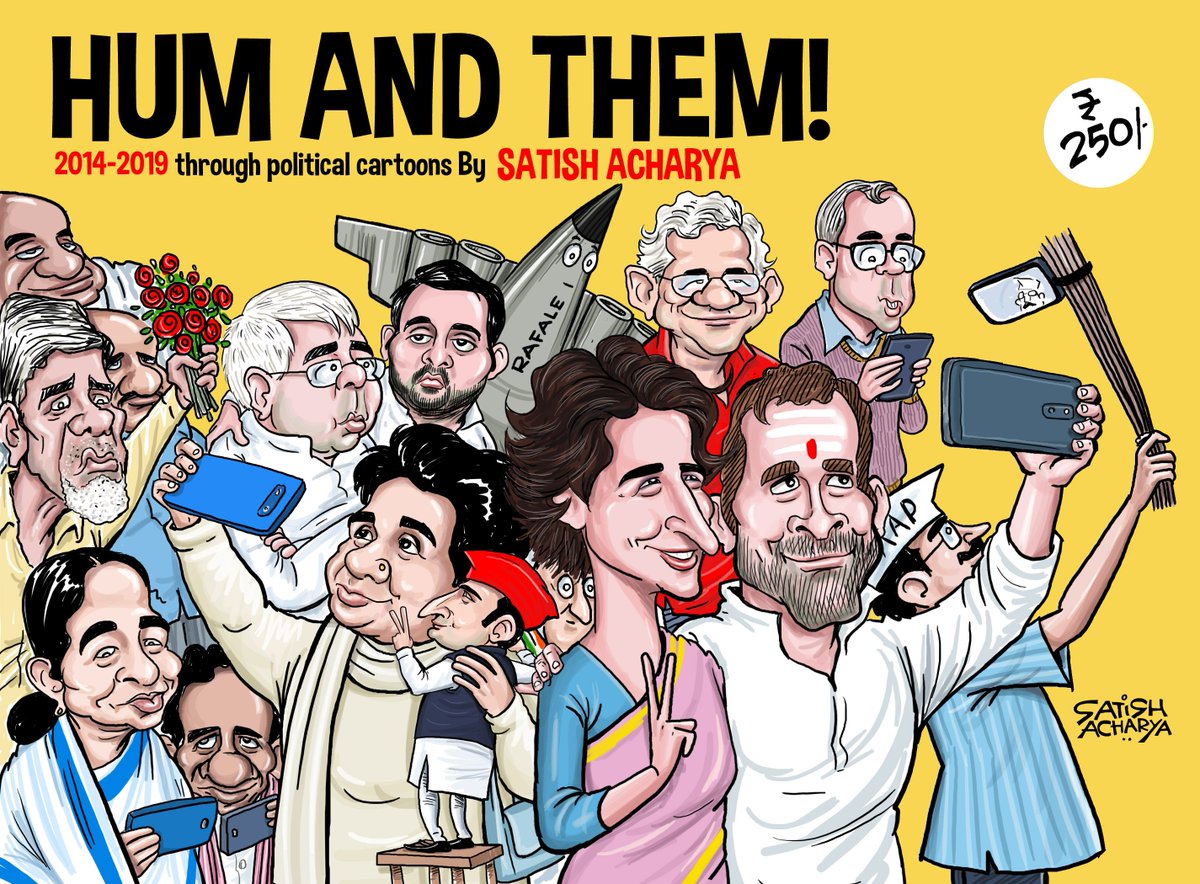
Caricature: Satish Acharya/@satishacharya
